
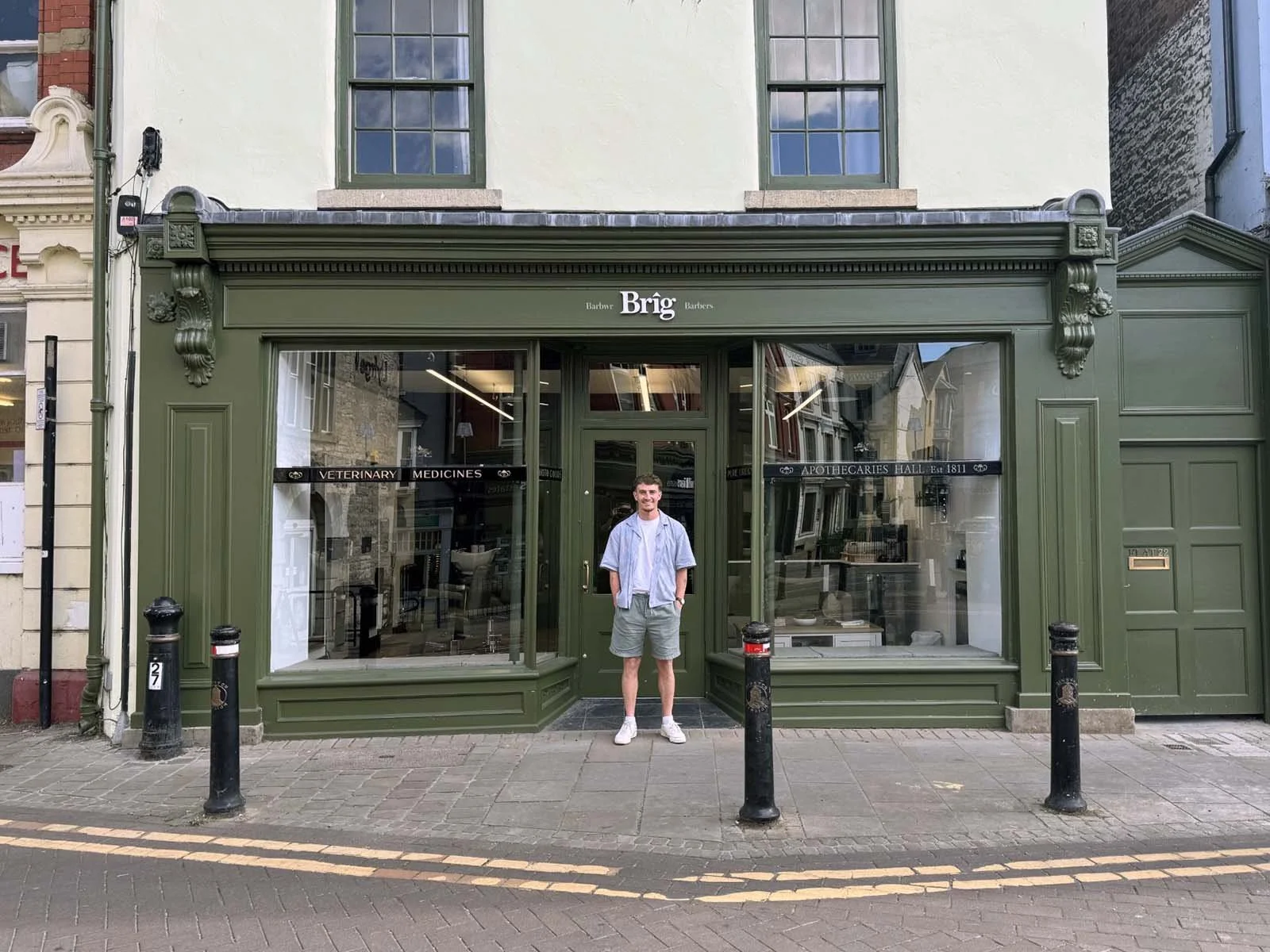
Opening your first business is a big step, particularly when it involves a listed building and creating everything from the space itself to the brand around it. For the latest Meet the Client, I sat down with my friend Matty to talk about the journey behind Brîg — from the first conversations about opening his own barbershop, through the design and listed building process, to opening the doors on Denbigh High Street.
▶︎ Brîg Barbers: Barber Shop Design & Refurbishment
The Interview with Matty
Tell us briefly about Brîg and how it started.
Having my own shop was always the ambition. I started cutting hair after Covid and managed to get into working in Chester quite early in my career, but eventually I always wanted my own place in the local area.
Brîg means something like a peak or crest in Welsh — the top of a hill or a wave. There isn't really a direct English translation. It just seemed to fit: the shop is at the top of town, we're surrounded by the Clwydian hills, I'm working on top of people's heads — and hopefully providing a top service!
What stage were you at when we first started working together?
It's difficult to say because we'd talked about it almost ever since we met!
We'd probably known each other for two or three years before it actually happened, so you were involved before it was really a solid idea.
Initially I thought I'd need help with the practical side — the layout, spacing and how everything would work. I knew you as an architect, so I didn't realise at first that you did all the branding and design work as well.
What were you hoping I could bring to the project?
Professional advice initially, but you gave me more than I expected.
You almost guided me through the process of opening the business and what I needed to do next. Without that, I think there would have been points where I'd have been stuck.
Then there was the listed building, which wasn't something I'd ever imagined having to deal with.
I consider myself quite artistic and wanted to have input into the design and brand. You never took that away from me. You used my ideas and developed them professionally rather than overpowering them or taking things in a direction I didn't want.
What was the process of working together actually like?
Easy and organised.
You moved things forward quickly — not rushing things, but getting to the point and getting things done.
Even though the opening ended up later than we'd originally hoped, we were generally ahead with everything that was within our control. It took a lot of the stress out of it and I always felt like things were organised.
Did having one person involved across the whole project make a difference?
For sure. There was less confusion and less chance of information getting lost between different people.
By the end you were almost part of the brand because you'd been involved from start to finish and understood the vision.
That became particularly obvious when we got to the products. By then you understood what I wanted without me having to explain everything.
There were occasions where you put your foot down and said, "No, I think this is right," and by that point I trusted you to make those decisions.
How useful were the visuals and mock-ups?
Really useful. It's difficult to visualise something that doesn't exist. You can have all these ideas in your head but you're never completely sure what they're actually going to look like.
Seeing the mock-ups and visuals changed that. They helped me, but they also helped everyone else working on the project understand what we were trying to achieve.
The shopfront is a good example. My original idea was different, but we had to work with what the listed building represented. What we ended up with was much simpler and more sympathetic to the building, and we've had loads of compliments about it.
Was there anything I challenged you on that particularly improved the project?
Definitely the flooring.
I'd originally talked about using a vinyl that looked like concrete. You were concerned that because everything else was quite simple and pared back, such a big part of the shop could end up looking cheap.
You pushed me towards spending more on a higher-quality floor. It's probably had as many compliments as anything in the shop, and hopefully the quality will show over the years too.
The layout was another one — things like using the bay windows for seating and making sure we utilised the space properly.
Was anything easier than you expected?
A lot of it, particularly the listed building and Building Control side.
The dialogue with the conservation officer was important. There were things you pushed back on rather than just accepting the first response, like keeping the seating in the bay windows.
I'm naturally quite easy-going, so I know how easily I could have just accepted some of those decisions. Having someone prepared to push when it was worthwhile ultimately benefited the business and the finished shop.
Did the finished shop turn out how you imagined?
Better.
Originally I wanted quite an industrial look, but the direction we eventually went in gave it a more high-end feel.
It feels more timeless. A lot of barbershops have that industrial look at the moment, but trends move on. What we've ended up with feels like something that can last.
It's actually made me more ambitious about where the business could go in the future.
What's been the reaction from customers?
All positive.
People seem genuinely happy to have this sort of barbershop in the local area. The idea was always to bring something with more of a city feel and level of quality to Denbigh, and people seem to have responded to that.
We've had loads of compliments about the shopfront too. It's simple, but because the building has been cleaned up and the signage is restrained, it actually stands out on the high street.
Looking back, what are you most proud of?
All of it, really.
I've only been doing this professionally for about five and a half years, so to go from being self-employed and renting a chair to owning my own shop on the high street in that time is something I'm proud of.
I'm proud that I actually committed to doing it, but ultimately it's the finished product and seeing everything come together.
At what point did it finally feel real?
It still doesn't!
I still get a buzz coming in in the morning and it all feels a bit surreal.
The first time it really started to hit me was when the renovation began. I'd known for about six months beforehand that it was happening and had been quite laid-back about it. Once the physical work started, that's when the nerves kicked in and it suddenly became real.
Reflection
What I've enjoyed most about Brîg is that it became far more than an architectural project.
From the listed building application and shop fit through to the branding, website, signage and products, I was able to work with Matty on almost every part of bringing the business to life.
But it always remained his project. Matty had a strong instinct for what he wanted Brîg to be; my role was to help develop those ideas, challenge them where I thought we could do better, and guide him through the parts of the process he hadn't encountered before.
The finished shop feels contemporary without fighting the listed building, distinctive without shouting, and most importantly, it feels like Matty.
Seeing him go from cutting my hair in Chester and talking about opening his own place "one day", to standing in his own shop on Denbigh High Street has been pretty special.
And I suspect this is only the beginning for Brîg.