
Designing a home around landscape and light is rarely as simple as adding larger windows or creating more space. More often, it’s about understanding why people connected with a property in the first place and carefully reshaping the way the home responds to its surroundings. For this journal entry, I wanted to reflect on a residential extension project in North Wales where the relationship between architecture, family life and the landscape became the driving force behind the entire design.
▶︎ House Extension & Refurbishment Overlooking The Clwydian Range
Behind The Project
There is often a moment early in a project where the priorities become clear. Sometimes it is a material, a memory, or a practical need for more space. Other times, it is something much simpler. A particular direction. A line of trees. The way the evening light falls across a field. A distant hillside that quietly becomes part of daily life.
This project began with a view.
Located in North Wales, the property already occupied a beautiful position within the landscape, overlooking the Clwydian Range and surrounding countryside. Like many homes, however, the original layout did very little to acknowledge what was outside. The existing arrangement felt inward-looking and disconnected from the setting around it. Key spaces lacked natural flow, circulation areas were inefficient, and the relationship between the home and garden felt fragmented.
Reconnecting The Home To Its Setting
The clients had purchased the property specifically because of its location and outlook, but the house itself wasn’t fully taking advantage of either. The brief quickly evolved beyond simply creating additional floor space. Instead, the focus became about improving the way the house felt to live in day-to-day — creating better connections between light, landscape and family life.
As an architect working across North Wales and the North West, this is something I encounter regularly. Many properties occupy incredible locations but have evolved over time through smaller, disconnected alterations that prioritise practicality over experience. Extensions become additions rather than considered parts of the home. Rooms are divided unnecessarily. Views are lost behind small openings, low ceilings or poor circulation.
Good residential architecture is not always about creating something dramatic or extravagant. More often, it is about understanding how people actually live and carefully reshaping spaces around that reality.
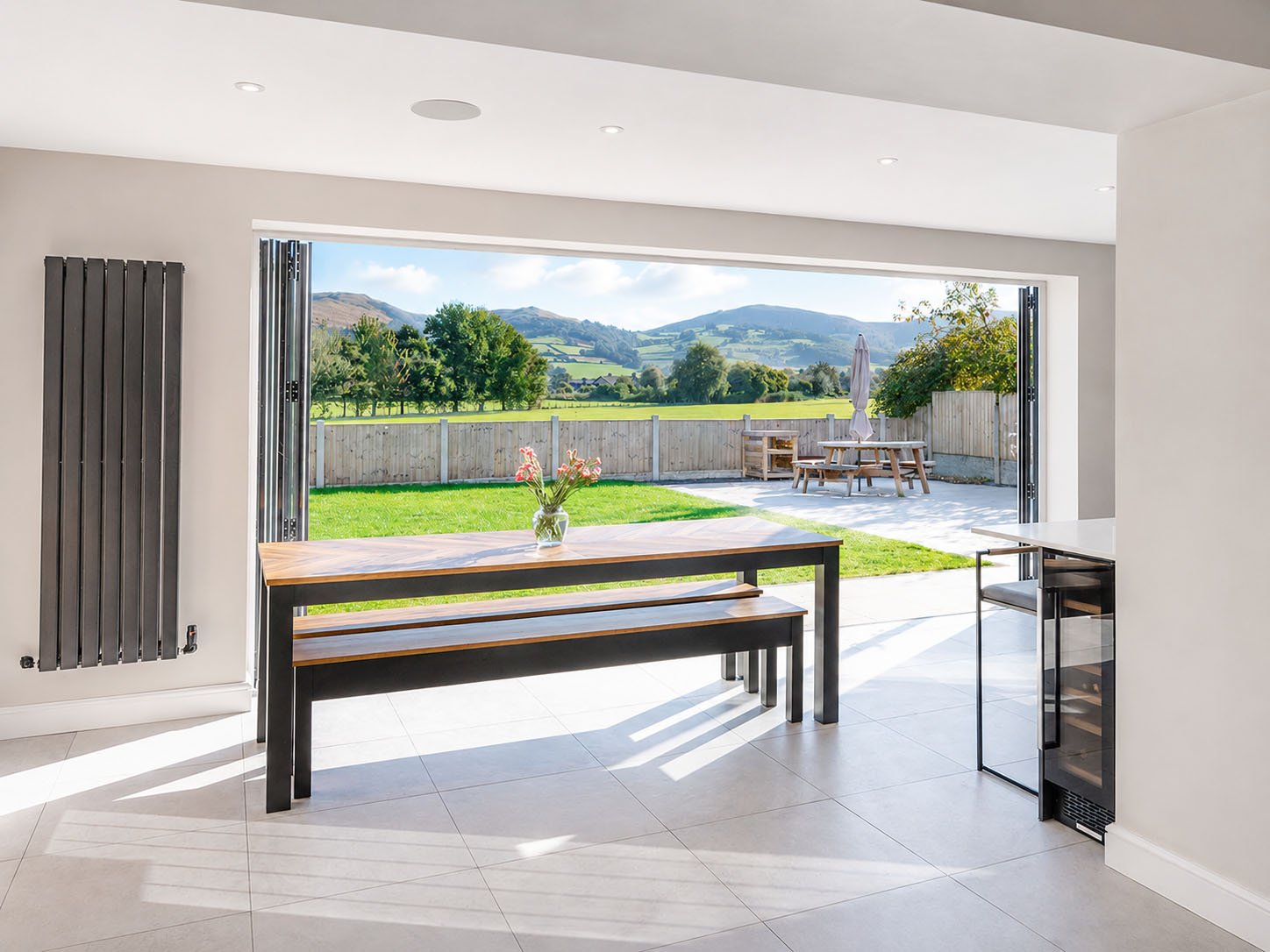
For this house extension project, the proposed design centred around creating a large open-plan kitchen, dining and family space that would become the heart of the home. The aim was not only to provide additional room, but to reorientate daily living towards the landscape beyond.
Large openings and carefully framed glazing were introduced to draw natural light deeper into the plan and strengthen the visual connection with the garden and distant hills. Internally, the arrangement was developed to improve flow between spaces while still retaining quieter, more intimate areas elsewhere within the property.
Designing With Restraint
One of the most important aspects of the design process was ensuring the new extension felt integrated with the existing home rather than appearing as an obvious addition. This often becomes the challenge with residential extensions, particularly within rural settings across Denbighshire and North Wales, where proportions, materials and scale can quickly feel out of place if not carefully considered.
The proposed forms and material palette were therefore kept relatively restrained, allowing the emphasis to remain on light, proportion and the relationship with the surrounding landscape. In many ways, the most successful parts of residential architecture are often the least obvious. Spaces should feel natural and intuitive, almost as though they were always meant to exist.
The Technical Reality Behind The Design
Of course, behind every seemingly simple space sits a significant amount of coordination and problem solving.
In this case, structural constraints played a major role in shaping the final design. Creating large open-plan areas and expansive glazing required careful consideration of spans, loading and support positions. Existing drainage routes and structural limitations within the original building also needed to be resolved sensitively without compromising the overall vision for the project.
This is often the reality of domestic architecture. Clients understandably see the final experience — the light, the openness, the atmosphere — but behind that sits a huge amount of technical coordination between architect, engineer, contractor and consultant teams to ensure spaces feel effortless.
There is also a balance that always needs to be achieved between openness and comfort. While large glazed spaces can create dramatic connections with the landscape, they also introduce considerations around solar gain, privacy, heat loss and practicality. Part of the design process is understanding where restraint is equally as important as ambition.
A Balcony That Changed The Experience Of The Home
As the project developed, the idea of creating a first-floor balcony became an important addition to the scheme. Interestingly, this was not something the clients had originally considered, but it quickly evolved into one of the defining features of the design.
Positioned to capture elevated views across the surrounding landscape, the balcony created a quieter, more personal connection with the setting beyond the house itself. Rather than simply increasing floor area, it introduced a completely different way of experiencing the property throughout the day.
Following completion of the project, the clients described the balcony as becoming their “go-to spot to enjoy the views in the evening” — a simple comment, but one that probably captures the success of the design better than any drawing or visualisation ever could.
These moments often become the most valued parts of a home. Not because they are extravagant, but because they encourage people to slow down and engage with their surroundings differently. Architecture has the ability to subtly shape behaviour in ways people do not always immediately recognise. A well-positioned window, a framed view, or a carefully considered threshold between inside and outside can completely change the atmosphere of a space.
More Than Additional Floor Space
Working on residential projects throughout North Wales, I often find that the most rewarding schemes are not necessarily the largest or most complex. They are the projects where small but thoughtful decisions significantly improve the way people experience their homes.
There is a tendency within the construction industry to focus heavily on square footage, specifications and visual impact. While these things all matter, they are rarely what clients remember most once a project is complete. More often, it is the quality of natural light in the morning, the way spaces connect during family gatherings, or the sense of calm created by a stronger relationship with the landscape around them.
That is ultimately what this project aimed to achieve.
A home that feels brighter, calmer and more connected to its setting. A layout that supports modern family life more naturally. Spaces that feel open without losing warmth or intimacy. Most importantly, a home that finally acknowledges the reason the clients fell in love with the property in the first place.
Good architecture rarely needs to shout. Sometimes, it simply needs to frame what was already there.